
Qena
A Redesign Approach to Digitization in Finance and Banking

FinTech AI
Designing an AI-powered digital lending platform that bridges financial institutions and underserved communities.
A unified platform that empowers banks, microfinance institutions, enterprises, and individuals by combining precision with AI-powered operations, fostering seamless collaboration, and connecting all stakeholders within a single integrated ecosystem.
Role
Product Designer and AI developer
UX Research • Product Strategy • Information Architecture • UI Design • Prototyping • AI-assisted Development (Cursor)
Every loan starts with trust.
When someone applies for a loan, they are rarely thinking about dashboards, workflows, or data architecture.
They're thinking about opening a business.
Buying farming equipment.
Paying school fees.
Growing something that matters.
On the other side of that application sits a financial institution trying to make fast, accurate lending decisions while managing risk across thousands of customers.
The challenge was that both sides depended on the same platform—but the experience worked well for neither.
Banks struggled with complex workflows and overwhelming interfaces.
Borrowers struggled with confusing onboarding and limited visibility into their loans.
The platform had grown quickly, but the experience had not evolved with it.
That was where our team came in.
Our mission wasn't simply to redesign screens.
It was to redesign how an entire lending ecosystem worked.
Background
Qena is an AI-powered Banking Platform as a Service (B/PASS) built for digital lending.
Its platform enables banks, microfinance institutions, fintech lenders, businesses, and individuals to manage digital lending operations through AI-powered credit scoring, automation, and psychometric data modeling.
By partnering with financial institutions, Qena helps expand access to financial services for underserved populations—including MSMEs, entrepreneurs, smallholder farmers, and individuals who often lack traditional credit histories.
The product already had powerful technology behind it.
The experience simply wasn't communicating that power.

Target audience
1. Financial Institutions (Primary B2B Audience)
The core audience includes banks, microfinance institutions, and fintech lenders seeking to digitize and modernize their lending operations. These organizations require secure, AI-driven tools to streamline loan origination, automate credit scoring, manage risk, and integrate with existing core banking systems. Their goals include improving operational efficiency, expanding financial inclusion, reducing default rates, and scaling digital lending services sustainably.
2. Small Businesses & MSMEs
Small and medium-sized enterprises (MSMEs), including entrepreneurs and smallholder farmers, represent a key borrower segment. These users often face barriers to traditional credit due to lack of collateral or limited financial history. They need accessible, transparent, and fast digital lending solutions that provide fair credit assessment, clear repayment tracking, and financial insights to support business growth.
3. Individual Borrowers
Individuals seeking personal or micro-loans form another critical audience. This includes underserved or underbanked populations who require simple, trustworthy, and easy-to-navigate financial tools. Their needs center around clarity, transparency in loan terms, accessible onboarding, and ongoing visibility into repayment progress.

The Challenge
Our first product audit revealed something interesting.
None of the individual usability issues were catastrophic.
But together they created constant friction.
The platform expected every user to navigate the same experience, regardless of whether they were:
-
a bank administrator managing thousands of loans
-
a business applying for financing
-
or an individual borrower checking repayments.
Different goals.
Different mental models.
One interface.
The result was unnecessary complexity for everyone.
We identified several recurring problems:
• Confusing information architecture
• No distinction between institutional and individual experiences
• One onboarding flow for every type of user
• Poor navigation
• No search
• Low accessibility due to weak color contrast
• Inconsistent visual language
• Data-heavy dashboards with little hierarchy
The more we explored the product, the clearer it became that this wasn't a visual design problem.
It was an experience architecture problem.
Understanding the People Behind the Platform
Before redesigning anything, we needed to understand who we were designing for.
We interviewed users across multiple audiences.
Financial institutions wanted operational efficiency, risk visibility, and scalable lending operations.
Business owners wanted faster access to funding with transparent repayment tracking.
Individual borrowers wanted simplicity, trust, and confidence while managing their loans.
Although their goals differed, they all shared one expectation.
They wanted financial technology that felt understandable.
Not intimidating.
Using interviews, affinity mapping, and synthesis workshops, we grouped recurring pain points into themes that later became our design priorities.
This research shifted our focus from simply improving usability to designing around different user intentions.
Conducted user interviews to dive deeper into the needs of wide range of people, including target users who use banking services on a daily basis and potential users who are interested in lending money from financial service providers including peoples who haven't tried it yet. By learning about their motivations, frustrations, and needs, we were able to gain user insights.
Reframing the Product
Instead of asking,
"How do we redesign the dashboard?"
we asked,
"How should each user experience digital lending?"
That question changed everything.
The redesign became less about creating beautiful interfaces and more about building the right experience for the right person.
Designing Two Experiences Instead of One
The biggest structural decision was separating the platform into two independent experiences.
Bank Portal
Designed for institutions managing lending operations.
Focused on:
• Portfolio performance
• Risk monitoring
• Loan management
• AI insights
• System integrations
Borrower Portal
Designed for businesses and individuals.
Focused on:
• Loan applications
• Repayment tracking
• Financial progress
• Clear status updates
• Simple navigation
Rather than forcing everyone through identical workflows, each experience was optimized around its own goals while remaining part of one connected ecosystem.
Simplifying Complexity
Financial products naturally contain large amounts of information.
The challenge wasn't removing complexity.
It was organizing it.
We redesigned the information architecture to reduce cognitive load by introducing:
-
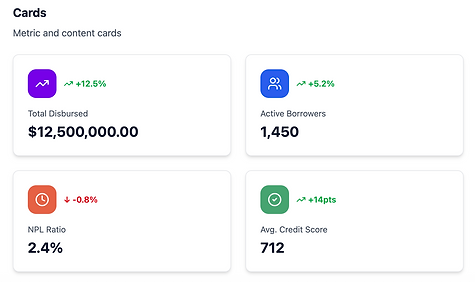
Modular dashboard cards
-
Progressive disclosure
-
Clear content hierarchy
-
Search functionality
-
Consistent navigation
-
Risk status indicators
-
Visual loan progress tracking
Instead of overwhelming users with everything at once, information became progressively available as users needed it.
The platform felt lighter without sacrificing functionality.
Designing Trust
Financial products succeed when users feel confident.
That confidence often comes from visual clarity rather than visual decoration.
Our visual system focused on consistency before aesthetics.
We developed a scalable design language built around:
-
Accessible color contrast
-
Consistent typography
-
Structured spacing
-
Modular UI components
-
Clear hierarchy
-
AI-inspired visual accents that reinforced innovation without compromising credibility
Every component was designed to scale as the product grows.

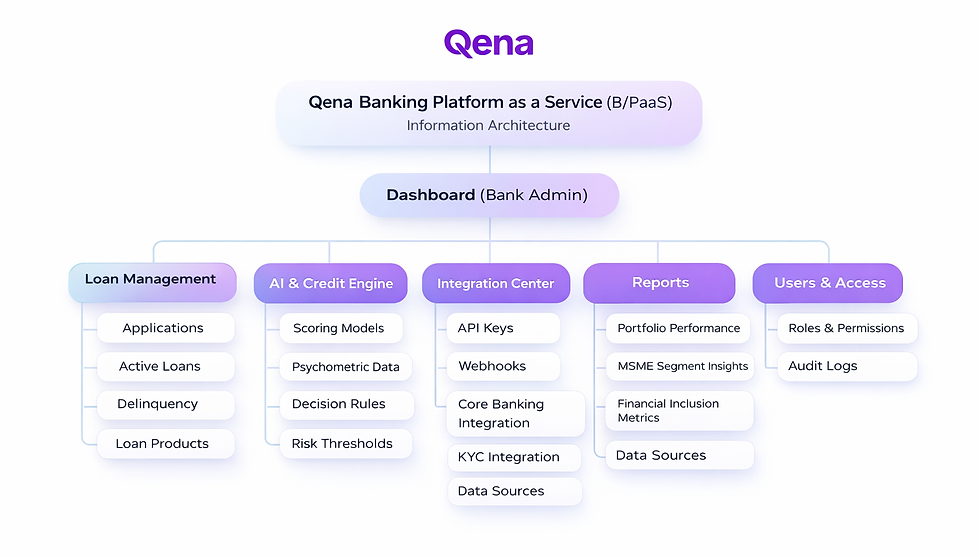
Information Architecture Redesign
I restructured the platform into clear role-based environments:
-
Bank Admin Portal
-
Individual User Portal
Each dashboard was designed around its core objectives:
-
Admin: Portfolio monitoring, risk management, integrations
-
User: Loan tracking, repayment, financial overview
Separate Onboarding Flows
Created tailored onboarding experiences:
-
Institutional verification & API integration for banks
-
Credit profile & loan application setup for individuals
Dashboard Optimization
-
Introduced modular KPI cards
-
Clear risk indicators and status tagging
-
Search functionality in top navigation
-
Data grouping through progressive disclosure
-
Simplified loan progress visualization
Adaptive Interface
Designed scalable layouts to support:
-
Data-dense enterprise use cases
-
Simplified views for individual borrowers
Visual & Brand System
Developed a consistent fintech visual language:
-
High-contrast accessible palette
-
Structured spacing system
-
Unified typography scale
-
Modern AI-forward aesthetic
User persona

Information architecture
Design System
Styleguide link


Icons


Spacing

Typography


Color palette and Typography


.png)


Crafting a Visual Language That Inspires Trust
The visual design evolved through multiple iterations, beginning with mood boards and creative exploration before progressing into a comprehensive design system and UI kit. Every visual decision—from color, typography, iconography, imagery, and spacing to branding and component design—was intentionally crafted to create a cohesive and scalable product experience.
Because the interface is where users build confidence in the platform, every design choice was guided by usability as much as aesthetics. The goal wasn't simply to create a modern-looking fintech product, but to design an experience that felt intuitive, trustworthy, and effortless to navigate for both financial institutions and individual borrowers.
Consistency became a core design principle. By establishing a unified visual language, reusable components, and clear interaction patterns, we created an interface that reduces cognitive load while making complex financial information easier to understand. Strong visual hierarchy, accessible color contrast, thoughtful spacing, and purposeful typography work together to guide users naturally through the platform, helping them focus on their tasks instead of learning the interface.
Validation included:
-
Internal stakeholder walkthroughs
-
Usability testing on dashboard navigation
-
Role-based scenario testing (Admin vs Borrower)
-
Accessibility contrast checks
-
Iterative refinement based on feedback
Focus was placed on:
-
Time to complete tasks
-
Error reduction
-
Ease of navigation
-
Comprehension of financial metrics

From Design to Production
One of the most rewarding parts of this project was seeing the work move beyond prototypes.
Using AI-assisted development tools such as Cursor, I helped implement the redesigned experience and accelerate production without compromising design consistency.
Rather than treating AI as a replacement for design, we used it as a collaborator.
It allowed us to translate validated UX decisions into production-ready interfaces more efficiently, shortening the gap between design and deployment.
Today, the redesigned platform is live.
Validating the Experience
Throughout the redesign we continuously tested our assumptions.
Validation included:
-
Stakeholder reviews
-
Usability testing
-
Role-based task scenarios
-
Accessibility evaluations
-
Iterative refinements
Our primary success metrics were straightforward:
Could users complete tasks faster?
Could they find information without confusion?
Did financial data become easier to understand?
Each testing round helped simplify the experience further.
Mockups
Admin Dashboard


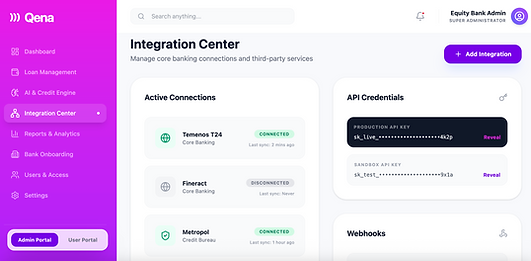


User Dashboard


Outcome
The redesign transformed the platform from a single generalized system into a scalable ecosystem capable of supporting very different users without compromising either experience.
The final platform delivers:
✓ Dedicated experiences for institutions and borrowers
✓ Simplified onboarding
✓ Clearer lending workflows
✓ Improved accessibility
✓ Better navigation
✓ Scalable information architecture
✓ AI-powered operational support
Most importantly, the product now aligns its technology with the people it serves.
Banks can make faster lending decisions.
Businesses gain easier access to financing.
Individuals experience digital lending with greater confidence and transparency.

Reflection
This project reinforced an important lesson.
Good financial products aren't defined by the amount of data they present.
They're defined by how clearly they help people make decisions.
By combining research, systems thinking, visual design, and AI-assisted implementation, we transformed a complex lending platform into an experience that scales across institutions and individuals alike.
For me, this project wasn't simply about redesigning software.
It was about designing trust at scale.


Visit website